Any Room

During the holidays, people travel a lot and stay in all types of places. Some opt to stay with family. Others choose hotels and motels for accomodations. A few may decide to stay at a bed and breakfast or maybe rent a cabin. On the other side of the equation are the hosts, hotels, motels, bed and breakfasts and cabin owners. These all must decide if they have available room for guests.

A key component of the story of Jesus’s birth involves travel and accomodations. Mary and Joseph travel to Bethlehem in response to a decree by the Roman Emperor. When they arrive, they search the city for a place to stay. The question which Joseph probably asked again and again was, “Do you have room for us?” This is a question which the Lord asks each of us still today. “Do you have room for me?” Ponder your response as you listen to Casting Crowns sing Make Room.
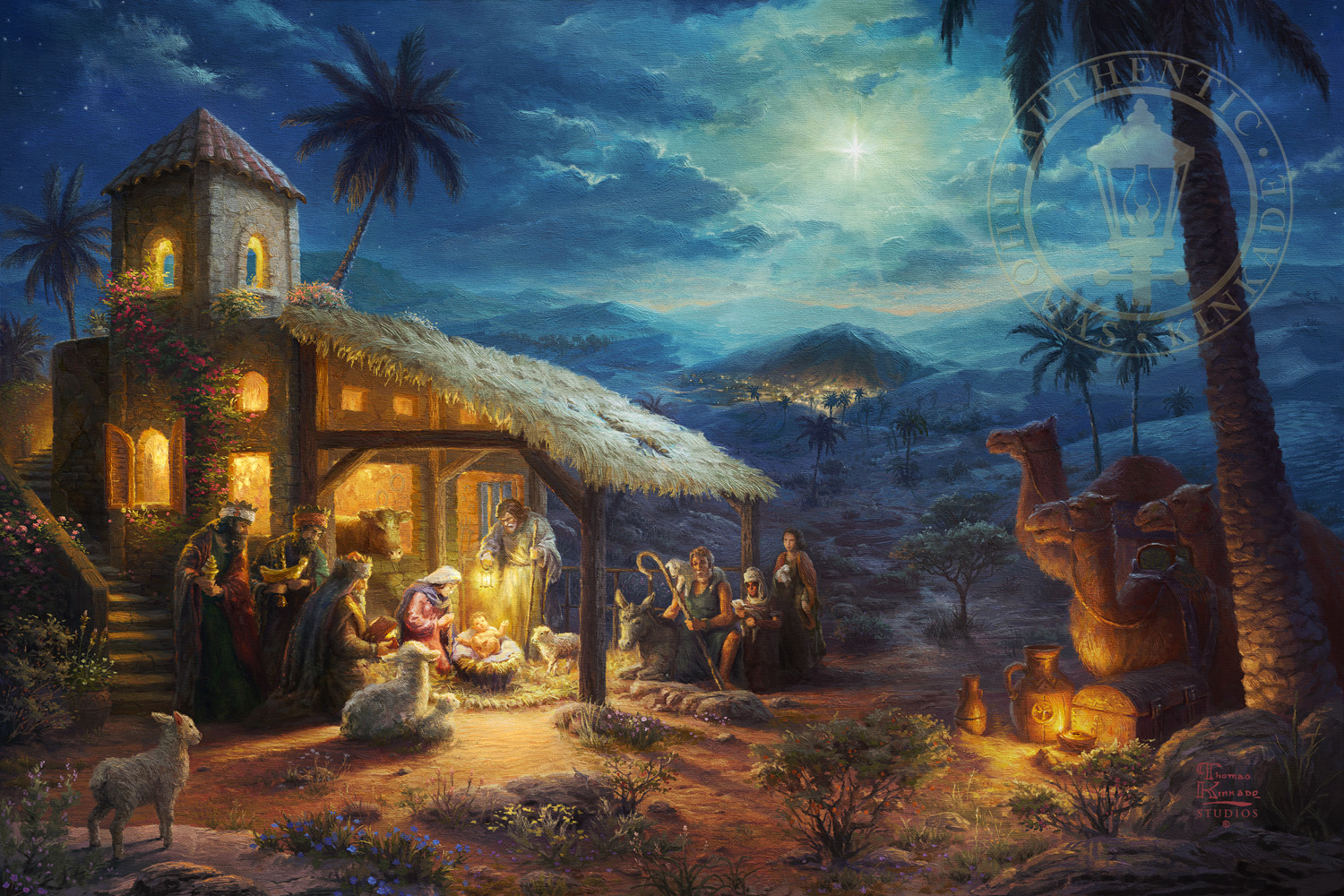
A Nativity

This time of year we see many nativity sits in homes, churches, and some community settings. One of the aspects of these which demonstrates some biblical inaccuracies is the inclusion of the three wisemen since their arrival was years after Jesus’s birth. However, custom has always included these wisemen in the overall narrative and therefore, in our nativity sets.

Thomas Kincade, a celebrated United States artist, who is known for his exceptional use of light in paintings. has captured the scene of the nativity in a painting which he titled, The Nativity. Take a moment to view this painting here…

1. How has Kincade’s use of light enhanced your view of the

nativity?

2. What seems unusual to you about this scene?

3. How does it differ, or capture, what is written in Matthew and Luke about Jesus’s birth?

4. Is there anything missing as you think about the scene?

5. How does this image make you feel about Jesus’s birth?

6. What do you think is the message which Kincade is trying to communicate in his painting?

Birth Announcement

Read Luke 1:5-20

If you are a Star Wars fan, you know that the first released movie trilogy was toward the middle of the whole story. Since the first three movies were released, we have received the three chapters of the story which were before the original movies. There have been prequels, sequels, individual character focus, and parts in between made into movies. Star Wars is not the only movie franchise which has included prequels and sequels. Some have also had spin-offs featuring characters from the original movie; i.e., the Marvel stories. We are even beginning to watch movies and anticipate these additional ones since it has become so commonplace.

Today’s passage is a necessary prequel to the story of Jesus Christ. We encounter Zechariah, one of God’s faithful priests, and his wife Elizabeth. Much like we will see in the announcement of Jesus’s impending birth, Zechariah is amazed at the angel’s words as he is consumed with fear and doubt. This presents us a precursor of the angelic announcement to Mary and Joseph. Because of Zechariah and Elizabeth’s age, the idea of a child being conceived is almost preposterous, similar to the unlikeliness of Mary becoming pregnant based on her circumstances. The child, John, will always be preparing people for Jesus and it begins with this announcement of  his upcoming birth.

As we continue to prepare for the celebration of Jesus’s birth and look toward the Savior’s return, this story of Zechariah, Elizabeth and John has value in our understanding of Jesus. John is the prequel to Jesus. This is why people were wondering if John was the Messiah. If we overlook John’s story, we lack the preparedness to experience Jesus’s story. Spending time discovering Zechariah and Elizabeth’s son John, helps us to anticipate Jesus’s birth and life.

Incarnation

Read John 1:1-14

John’s gospel account does not contain the narrative of Jesus’s birth like Matthew and Luke have done. Instead, the incarnation story is contained in what biblical scholars refer to as John’s prologue. In the prologue we hear of the Son, or Word, existing from the beginning. John tells us that the Son and God are one. The other significant aspects of the passage are the concepts of light and flesh.

John refers to Jesus as light shining unhindered into the darkness. This reminds us that the incarnation was an abrupt intrusion into the world. There is power in this light shining into the world. The light spreads to others as well. One of the reasons the Church chose to celebrate the incarnation on December 25 is because this is the darkest time for those living in the northern hemisphere where the Church was centered. The idea of light shining into their darkness was a meaningful illustration as presented by John’s gospel.

In this passage, John also speaks of the Word, or Son, becoming flesh. That is what we know as the incarnation, a deity taking on human flesh. No other faith tradition records an occurrence of this. There is a distinct separation of a god and humanity in all other religious systems. The concept that God became human and lived among humanity as Jesus is beyond understanding outside of Christianity.

John may not include the narrative of Matthew or Luke which included Jesus’s parents, shepherds, a stable, angels and a chorus of praise but John tells of the incarnation. God has become human and lived with humanity. God is as a bright, unquenchable light piercing into the darkness of the world and the lives of humans. This is what we celebrate on December 25.

What Do You Know

Read Luke 1:35-38

There is not a person on earth who can predict the future. We have no idea what is going to happen in the next thirty seconds, let alone a day, a month, a year, or ten years from now. We may have insights into possibilities and probabilities based on observations and patterns. But these predictions are not absolute and often lack some level of accurate detail. This is why many become frustrated with meteorologists because their weather predictions have a limited  level of accuracy.

So the song which I am sharing with you today is based on a question which is unfair to Mary. Mary’s announcement from the angel was alarming and unpredictable. How could Mary  ever know who and what Jesus would become? Even if she connected her child to the ancient prophecies, she could not know the details or timing. This song shares what we, on the other side of Jesus’s story, know happened. We know who Mary’s child is and what he has done.

As you listen to Mark Lowry’s version of the gospel, consider what you know about Mary’s child. How do you tell others what you know?

Message Received

Read Luke 1:26-33

Today we have so many ways to communicate. The use of electronic messaging is now commonplace and the top method of sharing a message with others. A person can feel overwhelmed at times with the number of messages received in one day. Some of these messages are uplifting, helpful, informative, and/or meaningful. Other messages are upsetting, destructive, trivial and/or annoying. There are times when we experience great joy with the message we receive. Still at other times we may be shocked by the contents of the message. Messages have the ability to inspire and motivate, or they can leave us scared and defeated.

The reading for today is a portion of Luke’s narrative on the birth of Jesus. A messenger of God comes to Mary. The greeting which the messenger offers is unsettling for Mary. She is informed to not worry because she is seen in a positive light by God. This is followed by the announcement that she is to conceive a son who God wishes to be named Jesus. The last statements in this portion of the message describes who this child will be in life. The description fits the prophecies regarding the Messiah. What an unnerving, and yet profound message Mary has received, a message she received because she chose to be open to it.

Many messages came our way on a daily basis. In reading about Mary’s receipt of a message, an obvious question presents itself, “Am I open to receive a message from God?” Since God does not use conventional means to deliver messages to us, we must be alert to the various ways God may choose to communicate with us. The most frequent method is through other people who God places in our path. But God uses Scripture, the arts, nature and even dreams as well. We may receive profound and life-changing messages as Mary did. We may also receive messages of reassurance, love, forgiveness, and hope. Whatever the message may be, we can only receive it if we are open and alert for it.

What To Bring

Read Isaiah 61:1-3

We are in the midst of the holiday season. Our calendars fill up with parties and family gatherings. A question which arises in preparation for such events is, “What should we bring?” The answer depends on the purpose of the gathering, the number of people in attendance, and the needs of the host. Determining what one is to bring is important to prevent social embarrassment and/or missing elements for the celebration.

The passages from the Book of Isaiah are the most frequently referenced insights in regard to the promised Messiah. Today’s reading is one of these passages. It is viewed as one description of the role of the coming Messiah. The list of actions attributed to the Messiah seem to describe Jesus’s ministry. The list can be understood as telling us what the Lord is going to bring into our lives.

As we examine our lives, we can see when the Lord has fulfilled this list for us. These promises provide for us reassurance and hope. Whatever we may be experiencing, we hear this proclamation of good news. Jesus has brought exactly what we need to the party of life.